
Salary Package Meaning: How Salary Packaging Works in Australia
By the Orry team · Published
What does salary package mean?
"Salary package" gets used for two different things in Australia, and mixing them up is how people end up comparing offers that aren't alike.
The first meaning is the total package in a job ad or offer. SEEK describes a salary package as the total combination of compensation and benefits an employer offers. The Australian Public Service uses the same idea in its remuneration reports: a total remuneration package is base salary plus benefits, and employer super is the main part of it above base salary. When an ad says "$100,000 package", it usually means a total like this, with super inside the number.
The second meaning is salary packaging, also called salary sacrifice. Moneysmart describes it as you and your employer packaging your salary into income and benefits, so some approved benefits are paid from your pre-tax pay. This is an arrangement you set up with your employer, not a way of describing the headline pay.
The rest of this guide covers both, starting with the question most people have when they read a job ad.
Does salary include super?
It depends on the wording, so read the words next to the number rather than the number alone.
For most employees, the employer has to pay super into their fund. The ATO says the super guarantee rate has been 12% since 1 July 2025. For employees under 18, super is only payable for weeks they work more than 30 hours.
What changes from ad to ad is whether that 12% sits inside or outside the headline figure:
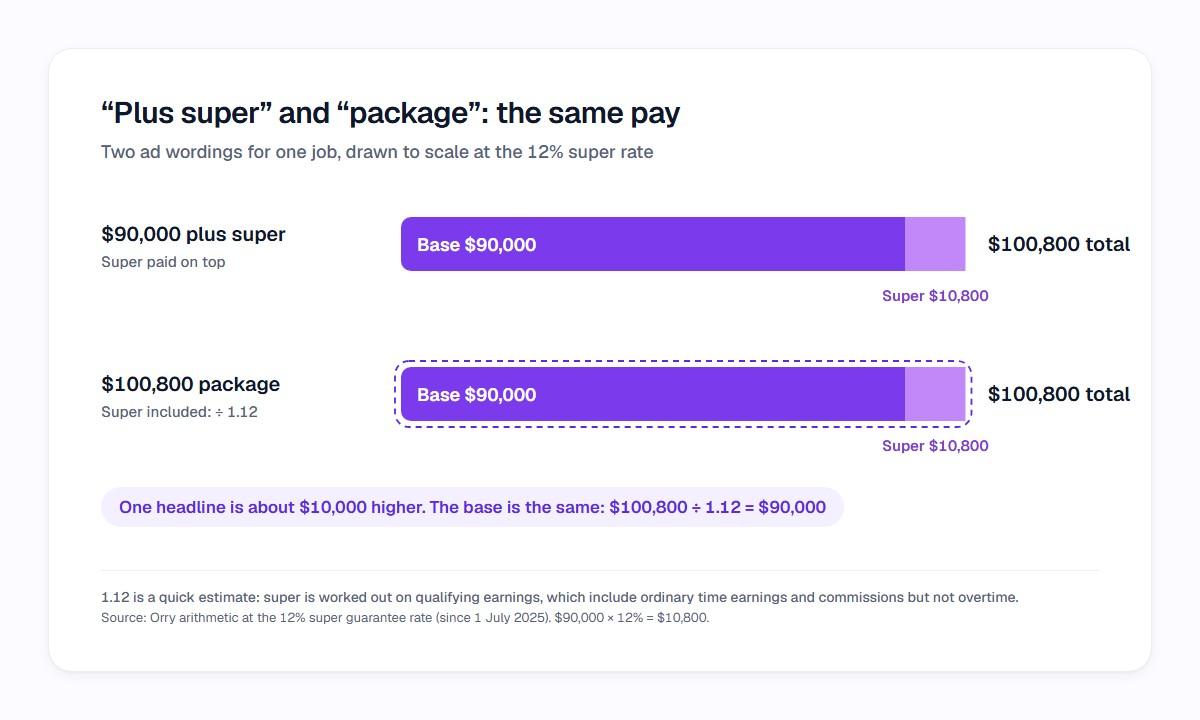
- "$90,000 + super" or "$90,000 plus super": $90,000 is the base salary and super is paid on top. At 12%, that is $10,800 of super, or $100,800 in total.
- "$100,800 package" or "$100,800 including super": the total is $100,800 and the base salary is $90,000. Divide a package by 1.12 to estimate the base.
- A number with no qualifier: genuinely unclear. Ask.
Those two ads describe roughly the same pay, even though one headline is about $10,000 higher. Using 1.12 is a quick estimate only: super is worked out on what the ATO now calls qualifying earnings, which include ordinary time earnings and commissions but not overtime.
One recent change is worth knowing. Since 1 July 2026, under Payday Super, Moneysmart says your employer must pay your super at the same time as your wages, and payments should reach your super account within 7 business days of payday. You can check your fund account after each pay instead of waiting for a quarterly payment.
How does salary packaging work?
Salary packaging is an agreement to take part of your pay as benefits instead of cash. Moneysmart's explanation boils down to a few points:
- You agree it with your employer in advance. You can't package salary you have already earned.
- The packaged benefits are paid from your pre-tax pay, which can lower your income tax.
- What you can package depends on your employer. Moneysmart's examples include computers, cars, childcare costs and super.
- Employers pay fringe benefits tax (FBT) on most packaged benefits, which limits what is worth offering.
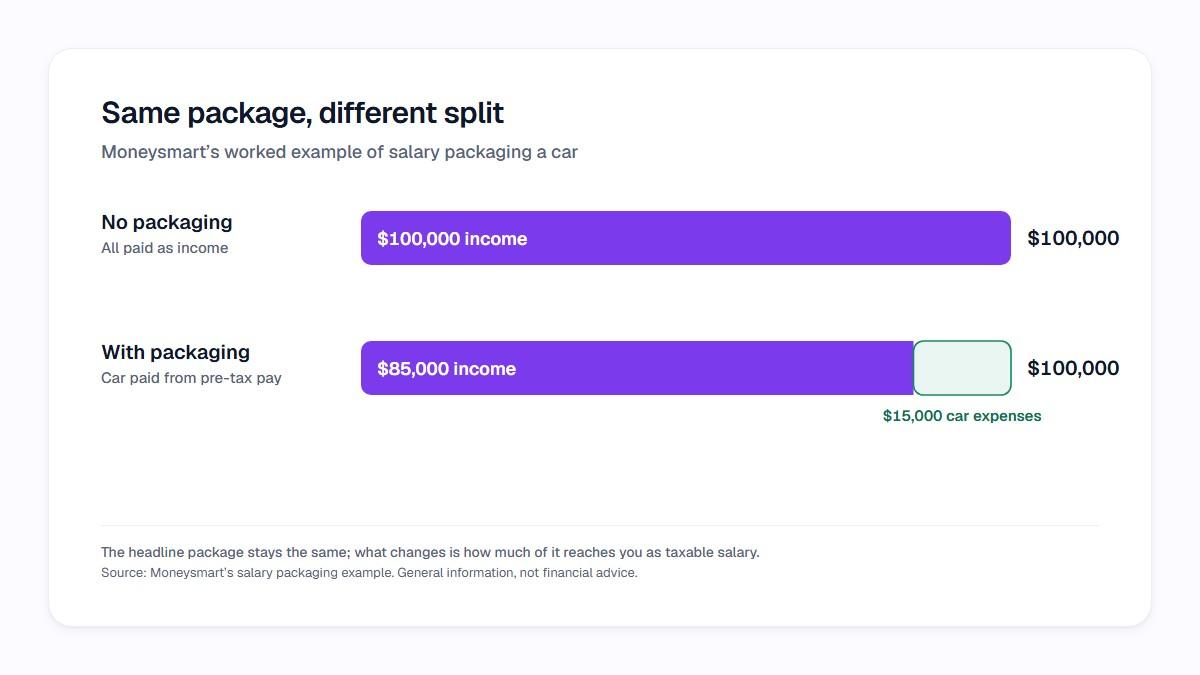
Moneysmart's worked example splits a $100,000 package into $85,000 of income and $15,000 of car expenses. The headline package stays the same; what changes is how much of it reaches you as taxable salary.
Moneysmart also says salary packaging is usually more effective for people on middle to high incomes, and that some not-for-profit organisations get FBT concessions or exemptions, which can make packaging more attractive for their staff. That is why salary packaging comes up so often in ads from charities, hospitals and other not-for-profit employers.
How does salary sacrificing into super work?
Packaging extra super is the most common form of salary sacrifice. You ask your employer to pay part of your pre-tax salary into your super fund on top of the compulsory amount.
Moneysmart notes that your fund taxes these contributions at 15%, the same as your employer's contributions, and that if you go over the yearly concessional limit of $32,500 you may need to pay extra tax. The ATO says salary-sacrificed super doesn't count towards the super guarantee your employer must pay, so it is on top of the compulsory amount.
Payday Super also changed how sacrifice affects your employer's 12%. The ATO's guidance on qualifying earnings says amounts you sacrifice into super still count towards qualifying earnings, so sacrificing to super doesn't shrink the employer contribution. Amounts you sacrifice to other benefits, such as a novated car lease, are not qualifying earnings. In other words, packaging a car can reduce the base your employer's super is calculated on.
This is general information, not financial advice. Moneysmart suggests talking to a financial adviser or registered tax agent if you are not sure whether packaging suits you.
How do you compare salary packages between jobs?
When two offers both use the word "package", put them on the same footing before you weigh anything else. Five questions cover most of it:
- Is the figure base salary, or a total that includes super?
- What else is inside the package: a car allowance, phone, bonus or other benefits?
- Is any of it variable, such as commission or a bonus that isn't guaranteed?
- Does the employer offer salary packaging, and what can you package?
- If you package something other than super, how does that change the super your employer pays?
SEEK's advice on packages is to work out which parts matter most to you and to speak to the employer about anything missing. Asking whether a figure is base or inclusive of super is a normal question at any stage.
Set your salary floor once, in one unit
The simplest way to avoid misreading packages is to decide your minimum salary as a base figure and convert every ad to that base before judging it.
That is how Career DNA works: you record your minimum salary along with your other priorities, such as office days, commute and deal breakers, and Orry scores every job you browse on SEEK and LinkedIn Jobs against them, with the reasons shown beside each Orry Score. When pay is what pulls a score down, you can see that it is pay. The score is guidance on fit, not a prediction of being hired.
If you would like your salary floor and other priorities checked on every job you browse, you can add Orry to Chrome and try it free.
See which jobs fit you before you open them.
Orry scores the jobs you browse on SEEK and LinkedIn Jobs against what matters to you, with the reasons.
For Chrome on your computer · Free to install · No credit card
Sources
- How are Australian salary packages calculated? (SEEK Career Advice, updated 28 July 2026)
- Chapter 4: Total remuneration package (APS Remuneration Report 2022, Australian Public Service Commission)
- Salary packaging (Moneysmart, ASIC)
- What is Payday Super? (Moneysmart, ASIC)
- The final SG rate increase is coming on 1 July (ATO)
- Work out if you have to pay super (ATO)
- Explaining qualifying earnings (ATO, Payday Super)
- What payments are qualifying earnings (ATO, Payday Super)
- Salary sacrificing (ATO, fringe benefits tax)
Researched with AI assistance and checked by a person before publishing: editorial policy.