
What Does Hybrid Mean in a Job Ad in Australia?
By the Orry team · Published
What does hybrid actually mean in an Australian job ad?
Hybrid means an employee splits their working time between a workplace and somewhere else, usually home. That is the whole definition. The word tells you a split exists. It does not tell you what the split is, who decides it, or whether it is written down anywhere.
Hiring glossaries make the same point: there is no standard definition of hybrid, and the term covers arrangements as different as fixed anchor days (say, Tuesday to Thursday on site), a minimum number of days per month, or a team-by-team call left to your future manager. Two ads that both say "hybrid working on offer" can mean one office day a week and four office days a week.
It helps to remember what a job ad is. It is written to attract applicants, so flexibility usually appears in its most appealing form near the top of the ad, while the specifics — if they exist — sit further down in the requirements or the benefits list. When the specifics are missing entirely, that absence is information too. It usually means the detail is still being decided, varies by team, or is less generous than the headline suggests.
What do common hybrid phrases really tell you?
Most Australian ads use a small set of stock phrases. Here is what each one typically leaves unanswered, so you know what to look for before you spend time on a long application.
None of these phrasings are red flags on their own. They are simply incomplete, and the gaps are the things worth confirming.
- "Hybrid working available" — available to whom, and from when? Sometimes it applies after probation, sometimes only to certain levels.
- "3 days in the office, 2 from home" — the clearest version. Still worth asking whether the three days are fixed or rostered.
- "Flexible working — we trust our people" — flexibility here may mean start and finish times rather than location.
- "Work from home up to two days a week once settled into the role" — a conditional offer. Ask who judges "settled" and how long that usually takes.
- "Office-based with flexibility" — closer to full-time on site than to hybrid in most cases.
- "Hybrid: client sites, office and home" — common in consulting, field and services roles. Your travel may be to several addresses, not one.
- "Remote-first" or "work from anywhere" — check whether there are quarterly on-site weeks, and which state the team sits in.
Where does hybrid show up on SEEK and LinkedIn Jobs?
On SEEK, many listings carry a work arrangement tag beside the location, so a result reads like "North Sydney, Sydney NSW (Hybrid)" or "Brisbane QLD (Remote)". On LinkedIn Jobs, the employer selects a workplace type — on-site, hybrid or remote — when the role is posted, and that choice is what powers the filters you use.
Two practical things follow. First, that tag is chosen by whoever posted the ad, so it can disagree with the body text; when they conflict, trust the body text and verify it with a human. Second, filtering by "hybrid" will quietly drop roles where the employer left the field blank but describes flexibility in the description. If flexibility matters to you, it is worth running your search both with and without the filter.
This is also where a lot of time disappears. Scrolling a long results page, opening tabs, reading halfway down each ad to find the office-days line — that is the part of searching that wears people out. Orry for SEEK sits inside your normal results and adds a personal score and the reasons behind it to each job, so the roles that match what you care about stand out before you open them.
Is hybrid work a right in Australia, or just a perk?
Advertised hybrid arrangements are an employer's current policy, not a legal entitlement. Separately, the Fair Work Act gives some employees a legal right to request a flexible working arrangement once they are employed. According to the Fair Work Ombudsman, full-time and part-time employees can make a request if they have completed at least 12 months of continuous service with that employer and they are pregnant, are the parent or carer of a school-age or younger child, are a carer within the meaning of the Carer Recognition Act 2010, have a disability, are 55 or older, are experiencing family and domestic violence, or are caring for or supporting an immediate family or household member experiencing it. Casual employees can be eligible where their employment has been regular and systematic.
The employer must respond in writing within 21 days, must discuss the request with the employee, and can only refuse on reasonable business grounds. Anyone can ask for flexibility at any time — the Act simply gives those groups a formal, enforceable process.
The practical takeaway for a job seeker is that an ad's hybrid promise sits outside that framework and can change. Return-to-office mandates at a number of large Australian employers have been widely reported, even as SEEK data reported in the press showed the share of ads offering work-from-home arrangements remained high. So it is fair to ask how the policy is documented: is the arrangement in the employment contract, in a written policy, or simply how the team currently works?
What should you ask a recruiter before you go further?
If an ad matters to you but the hybrid detail is thin, a short, polite message before or during the first call usually gets a straight answer. Ask about the arrangement as it is, not as you hope it will be.
Keep it to three or four questions. You are gathering facts, not negotiating yet.
- How many days on site each week, and are they fixed days or chosen by the team?
- Who decides — company policy, or the hiring manager?
- Is the arrangement in the contract, in a written policy, or informal?
- Which office is this role based at, and is there travel to other sites or client offices?
- Does work from home start immediately, or after probation?
- Are there core hours, or set days when the whole team is in?
- Has the policy changed in the past year, and is a change expected?
How do you compare hybrid roles without losing the thread?
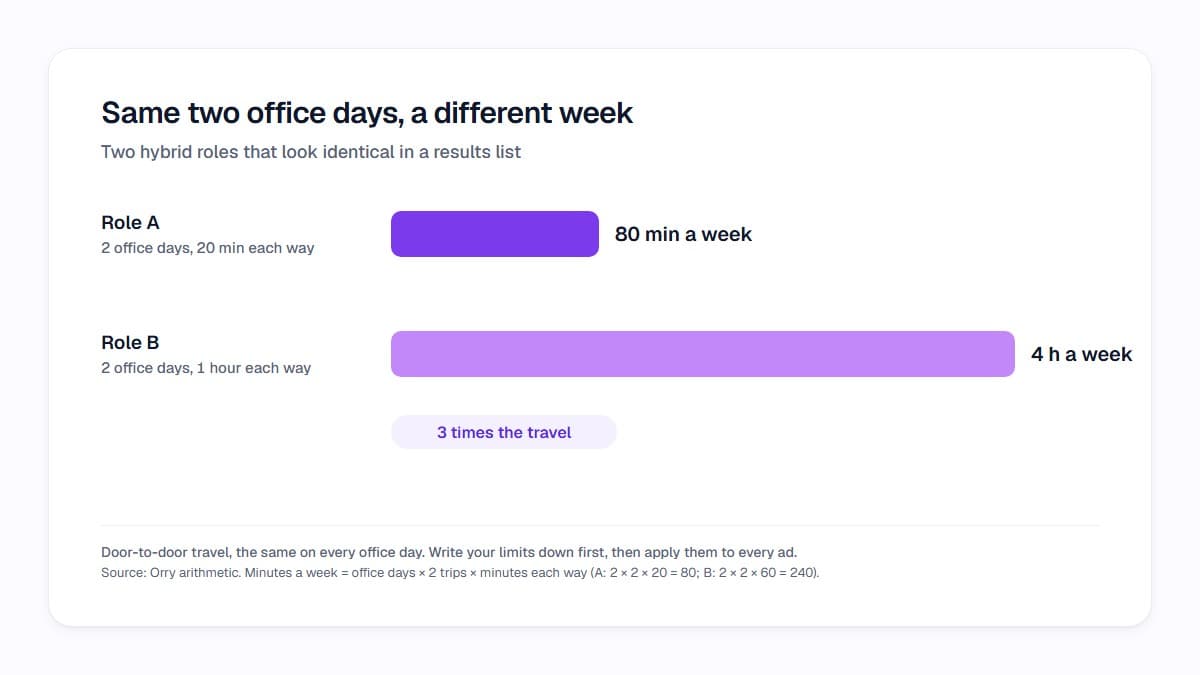
Once you are comparing a dozen ads, the real problem is not information, it is consistency. A role with two office days and a 20-minute commute is a very different proposition from one with two office days and an hour each way, yet both appear identically in a results list. Writing down your own limits first makes the comparison honest: the maximum number of commuting days you will take on, the maximum door-to-door travel time, your pay floor, and the non-negotiables around school pick-up, carer duties or study.
Then apply those limits the same way every time, including on the roles you like the look of. That is the discipline that is hardest to keep up at 11pm on a Tuesday. It is the reason Career DNA exists — you set your priorities once, and every job you browse on SEEK and LinkedIn is scored against them, with the reasons spelled out so you can see which factor pulled a score up or down. The score is about fit with what you said matters, nothing more.
Finally, treat the hybrid line as one input among several rather than the deciding one. Office days are easy to quantify, which makes them easy to over-weight against things like the actual work, the team, or the pay band. If the arrangement is genuinely unclear after an ad and a conversation, that uncertainty is simply a fact to record and weigh alongside everything else.
The short version
Hybrid is a category, not a commitment. Read the body of the ad rather than the tag, note the conditions attached to working from home, check whether the arrangement is documented, and ask the specific questions early so you are not discovering the office-day roster in week two. If you are eligible to request flexible working once employed, the Fair Work Ombudsman sets out how that process works and what timeframes apply.
If you would like the office-day detail, the commute and your other priorities weighed up on every job you browse, you can add Orry to Chrome and try it free. It works on SEEK and LinkedIn Jobs, and it shows you the reasoning behind every score.
See which jobs fit you before you open them.
Orry scores the jobs you browse on SEEK and LinkedIn Jobs against what matters to you, with the reasons.
Free to install · No credit card · Works on the sites you already use
Sources
- Requests for flexible working arrangements fact sheet - Fair Work Ombudsman
- Flexible working arrangements - Fair Work Ombudsman
- Hybrid work: Hiring glossary - join.com
- Hybrid Remote Meaning: What the Term Actually Means in a Job Ad - Monitask
- Post remote, hybrid, or on-site jobs with Job Wrapping - LinkedIn Help
- Hybrid Work From Home Jobs in All Sydney NSW - SEEK
- Number of job ads offering WFH arrangements still high amid return-to-office mandates: Seek data - The Nightly
Researched with AI assistance and checked by a person before publishing: editorial policy.